

2026 Energy Market Oulook
Published date: 3/02/26
Read time: 10 minutes
Welcome to our 2026 Energy Market Outlook blog where we take a look at the UK energy landscape brimming with complexity, uncertainty and opportunity. Join Ross Taylor, Customer Hedging Analyst as he offers a comprehensive outlook on the year ahead, delving into the shifting dynamics of gas, power, and adjacent commodities. Touching on pivotal market forces shaping prices, from ongoing geopolitical tensions and sanctions to evolving supply chains. Drawing on the lessons of 2025 and highlighting the most significant milestones for 2026, Ross provides practical insights for anyone navigating procurement and risk management. Whether you’re seeking to anticipate price movements, understand the impact of global events, or refine your hedging strategy, this blog is your essential guide to the trends and risks that will define the energy markets this year.

Geopolitical Tensions
To begin, let’s revisit one of the central themes of 2025: To what extent are ongoing geopolitical tensions and the ever-evolving global landscape likely to persist and influence the energy market in 2026?
As we enter 2026, geopolitical uncertainty remains one of the most influential forces shaping global energy markets. The Russia-Ukraine conflict continues without a clear resolution, as peace talks remain sporadic and inconclusive. Even if progress is made this coming year, any potential relaxation of sanctions would likely be slow and conditional, reinforcing Europe’s long-term shift toward alternative energy sources and LNG imports from regions such as the US which we take a closer look into later. This transition will reshape trade routes and supply chains, creating new dynamics that businesses must navigate. In the Middle East, persistent tensions between Israel and Iran, coupled with broader regional instability, continue to add complexity to global energy markets. Meanwhile, US foreign policy decisions, including sanctions enforcement and trade measures, continue to impact cross-border energy flows and investment priorities, adding another layer of unpredictability. US and EU sanctions are likely to remain a key driver of market dynamics throughout 2026. Restrictions on Russian oil and gas exports will continue to constrain traditional supply routes, accelerating Europe’s shift toward alternative energy sources. Beyond the sanctions themselves, the ongoing conflict is creating additional volatility. Strikes on critical infrastructure, such as Ukraine’s attack on the Russian port of Novorossiysk in November, highlight the vulnerability of oil and energy assets. Russian strikes on Ukraine’s energy infrastructure have been frequent throughout the four year war and have continued into early 2026. These attacks have significantly disrupted Ukraine’s domestic energy production, with neighbouring countries helping to compensate for the resulting shortfalls in gas and electricity supply 2025, Ukraine’s gas imports rose to a five year high, whilst a decline of 40-60% of domestic output was observed February through October, following repeated Russian assaults on key facilities as well as low gas inventories. Some analysts estimated that during the winter of 2025, Ukraine will require an additional approximately 4 bcm of gas to meet domestic demand. If these trends continue, Ukraine is likely to remain import dependent throughout the year.
Oil
Brent crude prices peaking sharply in early 2022, driven by post pandemic demand recovery and geopolitical supply shocks, before entering a prolonged downward trend through 2023–2025. Volatility persists, but each rebound is weaker than the last, reflecting easing supply constraints, slower global demand growth, and improved market balance. By early 2026, prices stabilise in the $60–70/bbl range, indicating a market that has cooled significantly from its 2022 highs and is now trading closer to pre crisis levels, although volatility persists. Recent geopolitical tensions in Venezuela and Iran could continue to impact 2026 crude prices.
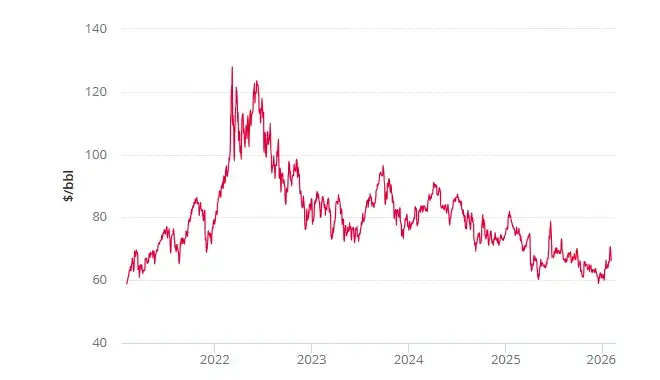
Oil prices have dominated headlines at the close of 2025 and into early 2026. The primary driver behind this attention is the notion of oversupply in the market. OPEC+ continued to incrementally bring back cut volume into the market into the final quarter of 2025, to the value of around 137,000 barrels per day. OPEC+ members have paused the planned increase of approximately 137,000 barrels per day (bpd) in oil production for January - March 2026. The decision was made in response to a stable economic outlook and what they described as healthy oil market fundamentals.
Geopolitical tensions have also played a role, most notably U.S. strikes on Venezuela. While these strikes have yet to disrupt production in the short term, Venezuela’s current output remains modest at just under 1 million barrels per day. However, the country holds the world’s largest proven reserves, approximately 300 billion barrels, accounting for 17% of global stock. The US President has signalled his intention to collaborate with U.S. oil companies to help boost Venezuelan production. Despite these geopolitical developments, recent trends in early 2026 show that market fundamentals continue to dominate. Elsewhere, the continued unrest in Iran has led to widespread political demonstrations across the country, resulting in multiple fatalities. Recently, the United States has even threatened intervention. Despite these developments, the oil market remains primarily driven by the imbalance between abundant supply and uneven demand, which continues to overshadow any short-term political shocks. However, this dynamic could change quickly given the region’s strategic importance. Close to Iran lies the Strait of Hormuz, a critical chokepoint for global oil flows and a significant vulnerability for energy markets. Any disruption or interference in this corridor could have far-reaching consequences, showing the current crisis in Iran a risk to global energy markets.

Storage
During 2025 the EU eased the storage targets which came into effect this Winter and will likely remain going forward. In summary, the EU have allowed member states to achieve storage targets between 01 October-01 December, for more information on the storage targets please read the 'Gas Storage Targets' blog. With the EU set to phase out all Russian gas imports by 2027, short term LNG contracts will end on 25 April 2026, followed by long term LNG contracts on 01 January 2027, while pipeline gas imports are scheduled to cease 30 September. As these deadlines approach, member states are increasingly turning to alternative suppliers to ensure they meet storage and security of supply targets. Norwegian pipeline gas remains a cornerstone of this strategy, supplying around 30% of EU gas imports in 2024, and this share is expected to stay strong as Russian volumes phase out. Meanwhile, the TurkStream pipeline continues to deliver Russian gas to parts of Southeast Europe, making it the only active route for Russian pipeline flows into the EU. Storage levels are highly weather-dependent, which underscores the importance of EU fill targets. Cold snaps can accelerate withdrawals, depleting reserves faster and increasing market volatility. Early in 2026, colder temperatures have driven elevated withdrawal rates from European gas storage, leaving inventories significantly lower than at the same point last year. Some analysts now warn that storage levels could fall below 30%, which, while supportive of spot prices, may also create risks that extend beyond the current withdrawal season. Reflecting these concerns, the Dutch TTF Summer 26–Winter 26 spread narrowed sharply in early January, with Winter-26 trading lower than Summer-26, highlighting the growing risk premium being priced into the summer period. With recent forecasts indicating colder than seasonal normal temperatures across February and into March, the continued reliance on the shoulder months for withdrawals is likely to add further volatility to curve prices. In addition, recent Russian strikes on Ukrainian gas infrastructure have raised concerns about security of supply, potentially increasing Ukraine’s reliance on EU support and limiting its role as a seasonal storage hub for European traders.
Carbon Markets
The EUA contract shows a clear upward trend, recovering from mid 2025 softness and climbing steadily toward £80-85/tonne by early 2026. In contrast, the UK ETS contract begins the period much lower but gains momentum through late 2025, rising from around £40/tonne, eventually eclipsing £70/tonne by January 2026. Overall, both markets strengthen into 2026, but EUAs maintain a premium over the UK ETS. Prices reflect tighter expected supply conditions and stronger compliance demand within the EU system.


In 2026, trading carbon credits between countries will get easier because new international rules under Article 6 of the Paris Agreement will introduce common standards for how credits are created, tracked, and exchanged. These rules will help ensure emissions reductions are genuine and not counted twice, making carbon credits more trustworthy and more easily traded globally. At the same time, the United States will officially withdraw from the Paris Agreement, as the current administration views it as disadvantaging the US while offering greater flexibility to major emitters like China and India. The United States notified withdrawal in 2025; withdrawal took effect in January 2026. The administration has also signalled exit from the UNFCCC. This shift signals a stronger domestic focus and reduced international coordination, adding uncertainty to global climate efforts. Meanwhile, the EU is tightening its carbon market by reducing the number of allowances available for auction in 2026, an updated EEX calendar shows a cut of about 52 million EUAs compared with the previous schedule, an 8.9% reduction, pushing prices higher and increasing compliance costs for European emitters. Against this backdrop of tightening supply and evolving international rules, hedge funds are entering 2026 with high long positions in EUAs, according to the ICE CoT report. A shift or continuation in sentiment away from these positions could introduce greater market volatility over the year.
LNG
Steady global LNG supply kept prices anchored within the $9–11/mmbtu range, while Henry Hub showed some late‑2025 upward pressure before easing back and stabilising as the new year began.
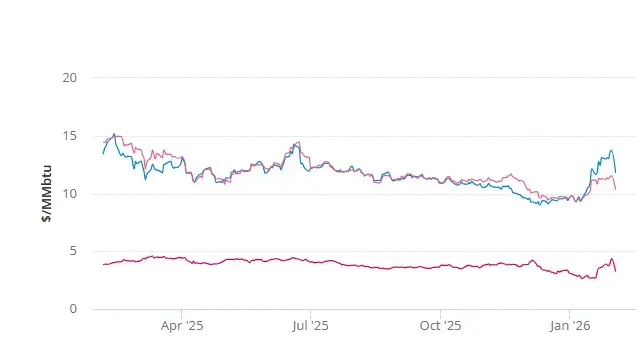
Since 2022, Europe has replaced lost Russian pipeline gas with LNG, often paying premium prices amid intense competition from Asia. After several years of tight markets, 2026 is expected to mark a turning point, driven by a significant supply surge from new U.S. projects such as Plaquemines and Golden Pass, alongside Qatar’s North Field expansion. At the same time, the EU’s phased ban on Russian LNG, starting in April and culminating in a full ban by year-end, will likely see redirection of Russian cargoes to Asia. From next year onward, a growing LNG surplus is expected to emerge in the global market, with analysts indicating that supply could exceed Europe’s underground storage capacity, which has historically acted as the primary balancing mechanism. However, there remains a risk that some of this new supply could be delayed, whether due to entire project start-ups being pushed back or unforeseen commissioning challenges.
Supply Glut – will demand follow?
Global LNG supply is set to rise sharply into 2026, easing market tightness and raising concerns about whether demand can keep pace. Despite this, global natural gas demand is forecast to grow around 2% in 2026, supported largely by renewed Asian buying as lower prices stimulate consumption in China and India, which demonstrates how expanding supply encourages price‑sensitive demand to return. Global growth is also anticipated in the latest World Economic Outlook, with forecasts suggesting global GDP to increase 3.3% in 2026, which in turn is likely to feed into gas demand outlook for the remainder of the year. Power demand is likewise expected to strengthen, with the analysts projecting global electricity consumption to rise by 1.7% in 2026 on the back of data‑centre growth amongst other factors.
French Nuclear Output remains key
French nuclear production shows a steady year on year improvement, and 2026 continues that trend with production climbing gradually through the year. The familiar seasonal pattern remains in place, with higher generation during the winter months and softer levels through the summer period. For 2026 the French nuclear company responsible for the 56-reactor strong fleet have announced they anticipate between 350-370 TWh.
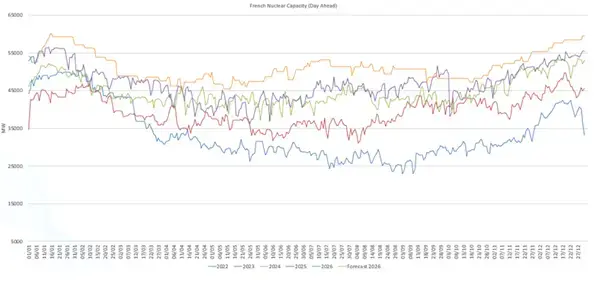
The UK energy market has benefited greatly from France’s strong nuclear generation, which provides a dependable source of imported electricity. These cross-border flows have become essential for reinforcing UK supply security, reducing exposure to potential shortages, and helping to stabilise wholesale prices during periods of domestic generation constraints. In 2025 Flamanville 3, France’s long-delayed EPR reactor, reached full power output (around 1,670 MW) in December after years of construction and testing. It was first connected to the grid in late 2024 and is now completing final performance checks before entering regular commercial operation. This milestone marks a major boost for France’s nuclear fleet and energy security. Forecasts for available capacity remain broadly positive as the year progresses, suggesting a stable outlook for supply. However, these projections are inherently dynamic and can shift due to a range of operational and environmental factors. Unplanned outages, prolonged maintenance schedules as well as other methods pose potential risks that could tighten capacity margins. Most recently, in January 2026, Storm Goretti caused issues to the grid at France’s Flamanville nuclear power plant, causing the reactors to remain offline until 01 February 2026. Last year, we saw jellyfish force a shutdown at French nuclear reactors after entering filters. Continuous monitoring and contingency planning will therefore be essential to manage these uncertainties effectively.

Other news
The April 2025 blackout across Spain and Portugal left over 50 million people without power for nearly 10 hours after a report from the European network of electricity transmission operators concluded was due to a voltage surge in southern Spain triggered cascading failures. The incident occurred during a period of limited voltage control, protective systems shut down large sections of the grid, and recovery was slow because of the scale of the collapse. A Reuters report noted that a final review, expected in the first quarter of 2026, will examine the underlying causes and the measures implemented to manage voltage across the system. In 2026, efforts focus on reinforcing grid stability through improved voltage control, added storage capacity, and stronger European interconnects, alongside resilience plans like Portugal’s €400 million investment in critical infrastructure and advanced control systems.
Current View
So far in 2026, prices have been bullish up to the time of writing. Several factors behind the 20%+ increase in the DA and front‑month gas and power contracts have already been discussed, including geopolitical tensions as well as fundamental drivers and the current storage situation. Another contributing factor behind the recent price uptick is the positioning seen in the CoT report, whereby ICE have posted the results from 16 January 2026. Investment funds have since swung into a net long position of nearly 58 TWh after previously being net short circa 55 TWh, marking a significant shift in market positioning.
Final thoughts
As we move through 2026, the energy markets are being shaped by a complex interplay of geopolitical uncertainty, shifting supply dynamics, and a rapid transition towards cleaner technologies. Although forecasts for oil, gas, and nuclear capacity presently suggest stability looking to the future, there remains a tangible risk of unexpected disruptions, whether from unplanned outages, weather-induced incidents, or evolving policy landscapes. The gas market has tightened in recent weeks on the back of the colder weather front that has been observed, and a drawdown of storages, leaving reserves less bountiful. These challenges highlight the importance of flexibility and robust risk management strategies. Structural changes are also underway, with LNG supplies increasing, carbon markets tightening, and greater integration of renewables, each contributing to the redefinition of trade flows and price formation across Europe. The events of the past year, from blackouts in Spain and Portugal to the operational challenges faced by France’s nuclear fleet, underscore the volatility inherent in today’s market environment.
For energy market participants and customers alike, staying ahead of these trends is essential. By closely tracking developments in supply, demand, policy, and technology, organisations can better anticipate market movements, manage risk, and seize emerging opportunities. In a landscape characterised by rapid change and heightened complexity, informed decision-making and proactive risk management are more vital than ever for maintaining competitiveness and ensuring long-term resilience.
Get in touch...
For further information on any of the topics covered in this blog, or to talk to our Energy Management team about your energy market needs get in touch today. We've a team of experts ready to help.
Please visit our BLOG pages to catch up with all our latest content and follow us on
LinkedIn for regular updates!